
Vol. 13
On desserts & disco

Dear Valentines,
For those of you out in California, we have good news to share: Smithees is swimming out west for two pop-ups! We’re cooking a collaborative tasting menu dinner with Troubadour Bread & Bistro in Sonoma on Saturday, February 21st before heading down to Los Angeles for an evening with Baby Bistro on Tuesday, February 24th. Come out and see us!
Here in New York we’ve been slipping along slushy streets and bracingly cold days, comfort to be found in opening the door to a warm room, the promise of a good meal, and maybe, if indulgence allows, a dessert to top it all off.
You might even be trying your hand at baking at home, the oven a welcome radiator, windows fogging up with condensation as you wait for the timer to go off. What is so indulgent, really, about dessert anyway? Is it not just a tiny sliver of happiness we deserve in an especially cold winter?
Baking is an act often tied to a kind of magic, to deep-seated nostalgia, to triumphing through trial-and-error, an emotional balm for our mishaps. In this issue, we talk to Tanya Bush, founder of Cake Zine, pastry chef extraordinaire, and author of the forthcoming cookbook Will This Make You Happy, about baking as an antidote to (or emblem of?) the messiness of life.
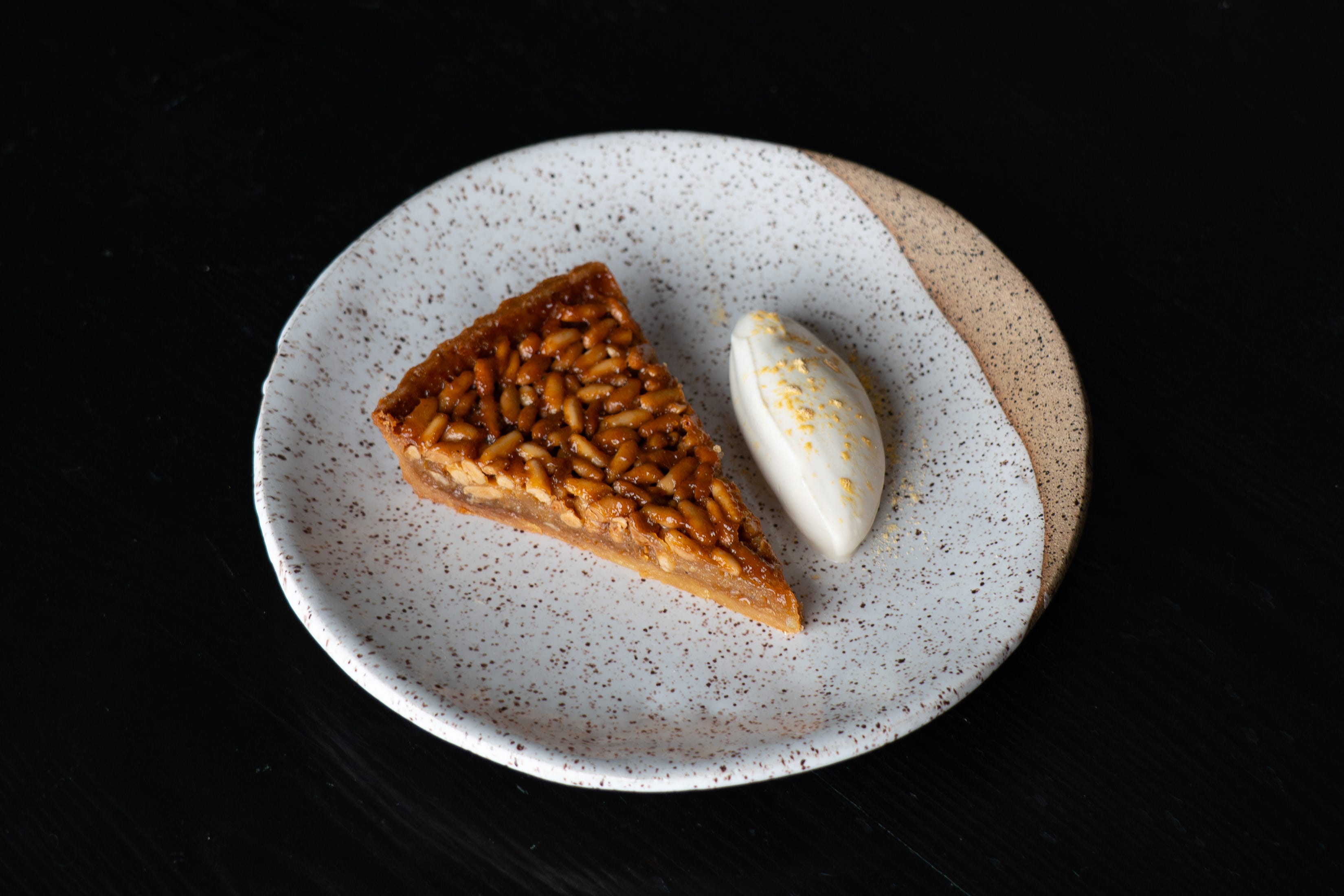
Then, we get into the eternal American allure of the donut, the circular meaning baked into that Homerian (Simpson, not Odyssean) ball of fried dough. And our first featured work of poetry finds a lesson in the pine nut tart, which is heading off the menu to make room for the confoundingly named Boston Cream Pie.
Stick with us—linger over dinner, and when someone inevitably asks: shall we get dessert? The answer is yes. Because in the gloaming of a long winter, we promise it will make you happy.
Smithereens
ps. it skipped our notice that we’re now 12 zines deep, making this lucky number 13 and marking a whole year of dispatches from yours truly. Thank you for following along <3
Is it Cake or is it Pie?
Behind the Dish: an inevitable classic graces the menu
—Nick Tamburo, Chef/Owner
“Boston Cream Pie:” one of most misleading desserts in the American culinary tradition. A cake masquerading as a pie? Who devised this deception? Did they call it a pie because cake is almost universally terrible? (Don’t @ me. Almost all cakes are dry and bad.)
In any case, it is the official dessert of the state of Massachusetts, the place where I was born. It was sort of inevitable that BCP would make its way onto the Smithereens dessert menu at some point. These days the flavors of Boston Cream Pie don’t seem particularly exciting (I mean, it’s literally cake with vanilla cream and a chocolate glaze) but in 1865, when chef Augustine Francois Anezin took over the kitchen at the Parker House Hotel, it was revolutionary.
Boston was home to the first chocolate mill in the United States but prior to the creation of BCP, chocolate was almost exclusively consumed as a beverage in the form of “drinking chocolate.” It wasn’t until the 1800s that the technology emerged to refine chocolate into an ingredient that could be used in cooking and baking. Thanks to chef Anezin and the Parker House Hotel, America was introduced to one of its first chocolate desserts.
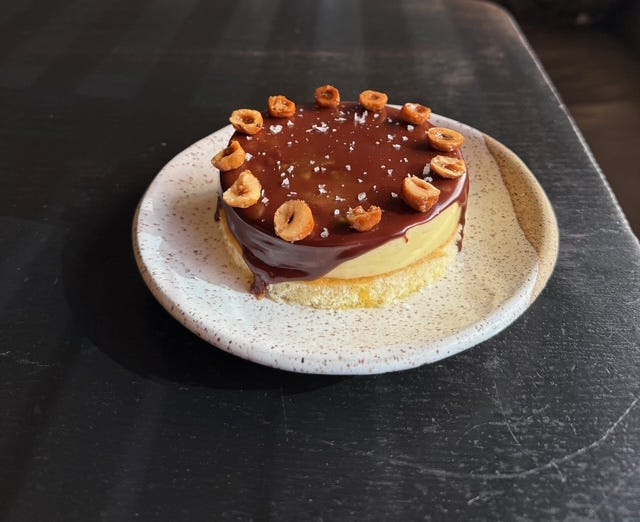
Our starting point for Boston Cream Pie was this recipe from a friend of mine, the great David Lebovitz. Our BCP is a small individual cake, rather than a slice of a larger one. We wanted it to look sleek and elegant, rather than rustic, so for our custard we turned to this technique from Alex Stupak, another native Masshole. We just had to incorporate some kappa carrageenan as well as iota, in order to make it a bit more stable. Once we had our form figured out, we turned to refining the flavor. We decided to soak the cake in a syrup made from fresh passion fruit and used a really nice 70% chocolate from Virunga. Then we finished the cake with some candied hazelnuts.
Oh yeah, and we decided to just use one cake instead of two . . . can I even call this thing Boston Cream Pie at this point?
Will This Make You Happy?
Nico Villasenor, chef de cuisine, chats with writer and baker Tanya Bush (aka cofounder of the much-adored Cake Zine and candid chronicler of wresting meaning and delight from the messy alchemy of baking over on will.this.make.me.happy).
I first met Tanya through Little Egg, where she’s the pastry chef churning out their beloved crullers; I came to eat with a mutual friend and she sent us a bunch of extra pastries that blew my mind.
Then she became a regular at Fradei, my last head chef job before Smithereens, and by now we’ve collaborated on a few desserts. Next month, Tanya is publishing her first cookbook; Will This Make You Happy is out on March 3rd, and we sat down to talk about baking and the art of failure.
Ok so first, I just have to share that the first time I had one of your pastries, the cruller, it changed my whole perspective. Crullers were always a disappointment growing up; why eat a soggy, sad version of a churro, when normal donuts are just so much better?
But the first time I went to Little Egg maybe 3 or 4 years ago at this point, you sent a cruller and I feel like I had a Ratatouille experience with fireworks going off in my head, thank you for that.
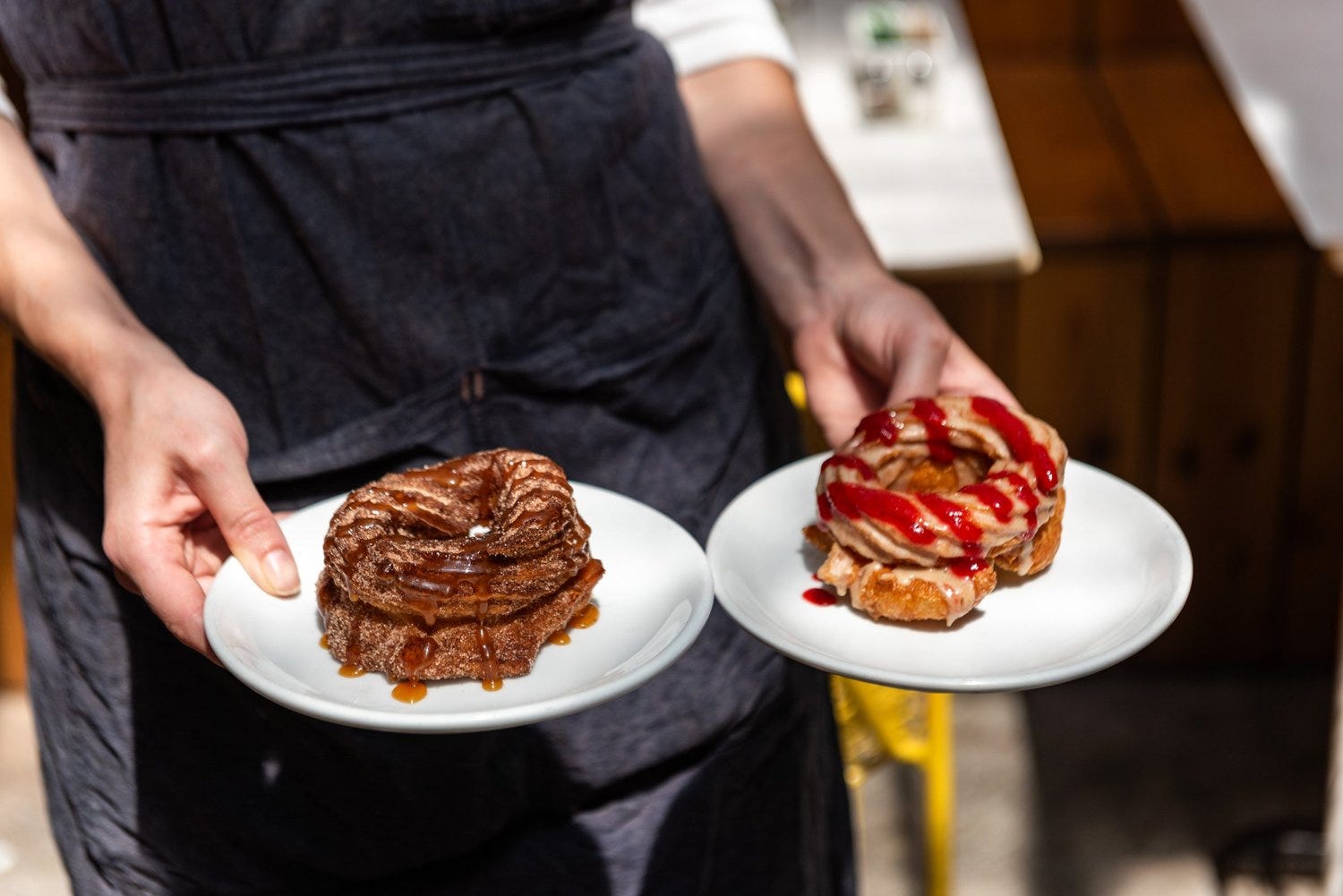
So on that note, I ask you: Fuck, marry, kill—cruller, cake donut, raised donut?
Fuck raised doughnut, marry cruller, kill cake doughnut.
In Will This Make You Happy, you write: “Failure is inevitable.” What are some of your favorite salvaged disasters?
One recent humiliation involved making creme caramels for a pop-up: hovering over the oven trying to gauge whether they were set, that horrible, breathless unmolding and the tragedy of overturning them to hear a squelch and discover a slumping mass of both curdled and entirely liquid cream. Legitimately disgusting. I puréed them, strained the mixture through a fine mesh sieve, then cooked it on the stove with a little cornstarch until it became a pudding instead.
How else do you confront failure gracefully, whether in baking or life?
I try to remember that most things don’t turn out perfectly the first time and I shouldn’t expect them to.
I have so many stories of dishes I was certain would work but ended up being total flops. From one cook to another, I always find it rare to successfully get a dish exactly how I want it on the first try. But honestly that’s the fun part for me, always honing a dish—or at least attempting to. Do you feel similarly when creating desserts?
Yes! With pastries specifically, I do believe that if you’re working from a base recipe you like and iterating on top of it, the chances of it turning out well are much higher. I like to think of pastry as a canvas for experimentation. Once I’m happy with a dough, a brioche for example, I start thinking about all the ways I can manipulate it, into a danish or a cinnamon bun or a doughnut, and then how I want to play with flavor in each context. For a cinnamon bun, I’ll brown the butter and use cardamom or hojicha instead of cinnamon. I’ll add tahini to the cream cheese frosting to give it a savory edge. I taste and adjust as I go, the same way I do when I cook at home.
Do you have a creative process when you R&D new dishes?
I have a notes app with flavor combinations and ideas I’m interested in trying: blackberry and lavender princess cake, pretzel-fy the cruller, goat milk ice cream with sage! When I have spare time in the kitchen I consult the list.
What is your favorite childhood dessert?
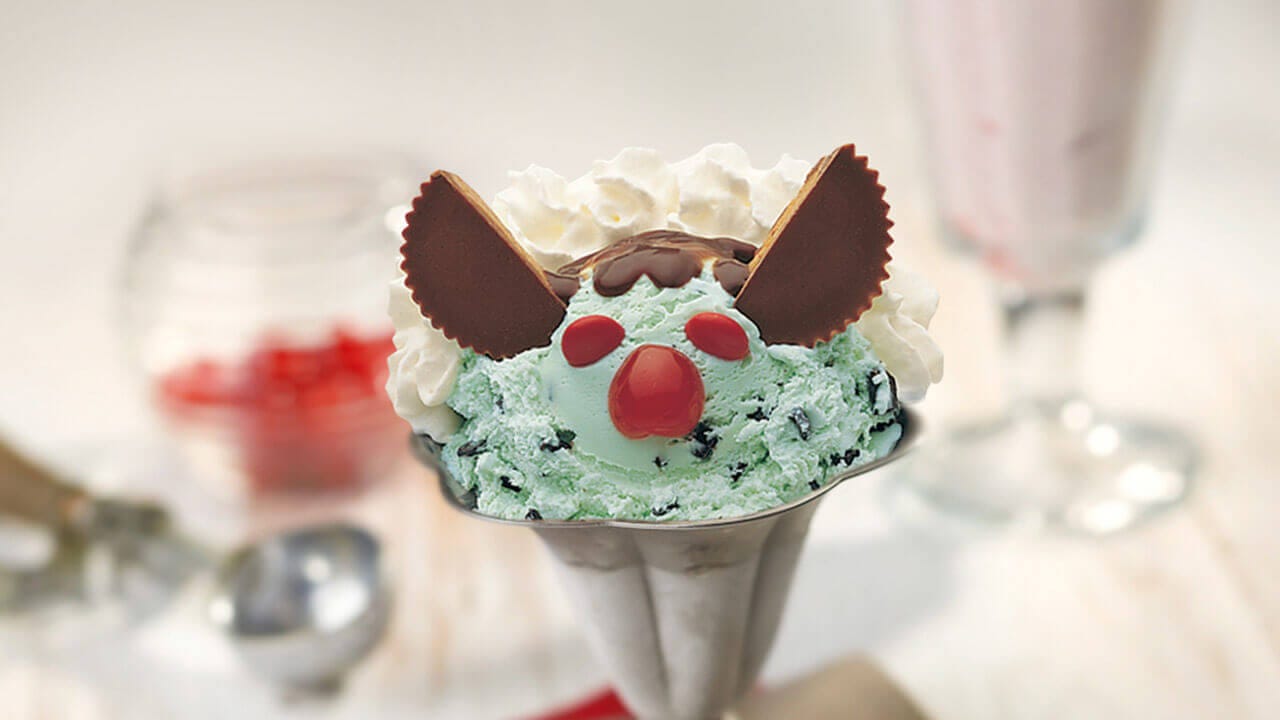
Monster Mash Sundae at Friendly’s.
What is your opinion on boxed cake?
Pro, but gussy it up. Pair it with a homemade frosting or anglaise.
What dessert trend in nyc needs to go?
Croissant gimmicks.
Favorite dessert to order at a restaurant?
If tres leches is on the menu, I’m ordering it.
Best dessert cookbook/chef?
Brooks Headley’s Fancy Desserts forever and Amanda Perdomo.
Favorite Ice cream flavor?
Cookies and Cream.
Why did you get into baking?
I just wanted to make something! Anything!
Best cake?
Carrot cake…ideally covered in potato chips.
What is dessert?
The point of it all.
Ice cream in the winter?
Yes, but preferably smothered in hot fudge.
What’s a Doughnut Without a (W)hole?
—Jacob Dorman, server/head bartender
The first thing to consider is the spelling: “doughnut” or “donut?” The latter, the more modern spelling, has been around since at least 1900; its first known printing is in Peck’s Bad Boy and His Pa by George Peck, writer and 17th governor of Wisconsin. It did not, however, gain popularity until the mid 20th century, largely thanks to chains like Dunkin’ and Mister.
76 or so years later I think it’s safe to say that donut has won, at least stateside. It’s even the preferred house spelling on our own dessert menu. All that being said, if “doughnut” is good enough for Sylvia Plath and Krispy Kreme (superior to Dunkin’, sorry New Englanders), it’s good enough for me.

Consider the doughnut, then. Our humble ring of fried dough. History in hog fat.
We can trace its roots to the Roman empire—a recipe for a “deep fried dough ball” appears in De Agri Cultura, Cato the Elder’s treatise on Roman agriculture. What this historical antecedent lacks, of course, is the hole. The doughnut is not defined by fried dough, after all, it is defined by its lack thereof in the center.
For that, we look to the 13th century. In an Arabic cookbook written by Ibn Razīn al-Tujībī (one of the few surviving cookbooks that date back to Moorish Spain), we find a recipe for sfenj, which requires forming a hole in the center of a ball of dough to test its proofing before frying. Sfenj are still popular in North Africa, where many Muslim Andalusi refugees fled; they’re now commonly referred to as ‘Maghrebi’ doughnuts.
Jump forward seven or so centuries and the doughnut reigns supreme in the American economy of fried dough. Beignets may have their stranglehold on New Orleans, and your state fair may be attempting various perversions in the genre of “deep fried,” but there is no serious threat to the dominance of the doughnut. Dunkin’ and Krispy Kreme proliferate, of course, while smaller, hipper, artisanal doughnut slingers dot the streets of most cities (to the point that Minneapolis’s Glam Doll Donuts recently had the ignominious distinction of being the backdrop to the Alex Pretti assassination), and you can find a doughnut on the menus of many cafés and restaurants (ahem), no matter which state you call home.
Why does the doughnut persist?
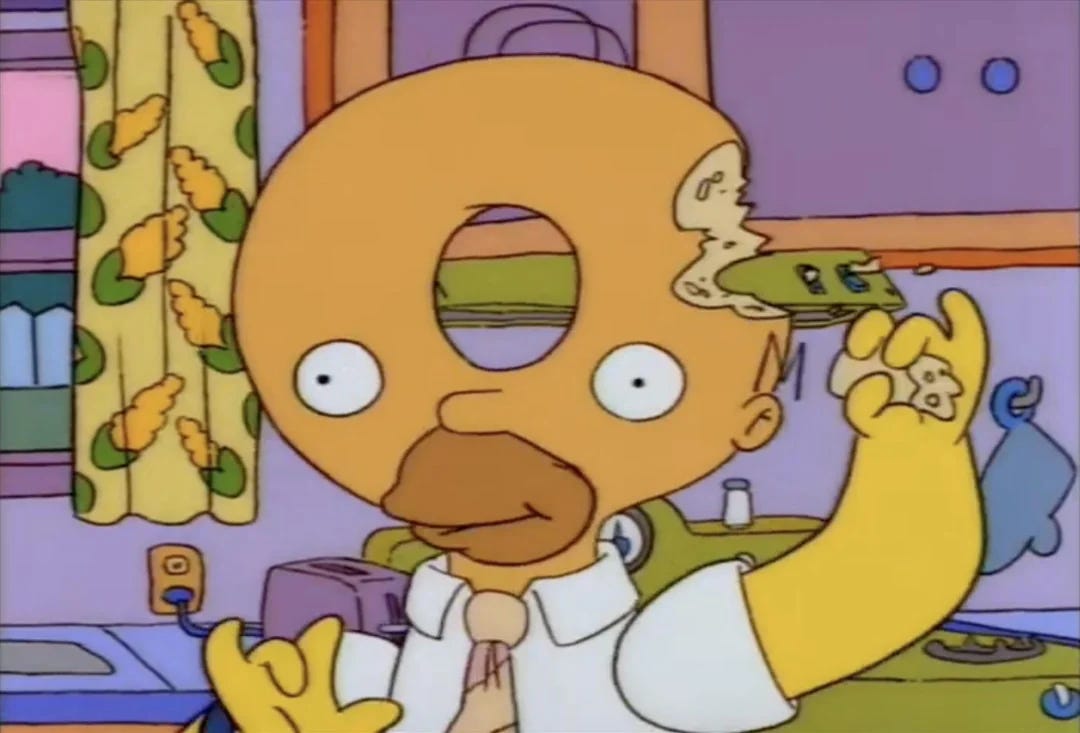
When I first started thinking about doughnuts I, of course, thought of their most famous and dedicated fan: Homer Simpson. He is the American man for what turns out may be fin de siècle America, so it’s fitting that his ‘sweet little treat’ of choice is the doughnut. Could we imagine Homer being obsessed with any other popular confection? I cannot. The doughnut is utilitarian and versatile in a way that other desserts are not; the doughnut is the dessert of the everyman. Walking around with a slice of cake in your hand at 9:00 AM or eating pie on the subway would condemn you to a life of (deserved) ridicule and/or suspicion but doing either with a doughnut? Normal ass behavior.
While writing this I also kept thinking about another American dad, Don Draper. His greatest pitches were always about nostalgia—and it is nostalgia that ultimately imbues the doughnut with its cultural weight.
I remember the first time I went to a Krispy Kreme. It was a big deal in Connecticut (firmly Dunkin’ territory), when it was announced in 2002 that a Krispy would be opening in Newington. When my dad finally acquiesced and took me a few months after they opened, the line was still well into the parking lot. I remember the sublimity of the hot doughnuts they handed you off the line. I had never had a hot doughnut before. They were smaller than the cakey behemoths I got at Dunkin’; I ate at least three while waiting to get our dozen. To this day, I don’t know that I’ve had a better doughnut than that first one in line at Krispy Kreme; but more importantly I remember how fun it was to be waiting in line with my dad and be handed these golden rings like manna from heaven.
The memories are sweeter than the doughnuts themselves, however, and the Dunkin’ monopoly on New England is real. The coda to this memory is that the first Krispy Kreme in Connecticut closed in 2005. We do not cry for a corporation (they still have a Connecticut outpost in the Mohegan Sun Casino anyway), but perhaps we do get a little misty eyed at the remembrance of doughnuts past.
We remember boxes of munchkins brought into school for birthdays. We remember cardboard boxes at family gatherings, the disappointment of finding only plain glazed because we were too late to the bounty. We remember our grandmother sneaking us a second after mom said one was enough. I remember The Donut Dip in West Springfield, Massachusetts, my girlfriend remembers Fox’s Donut Den in Nashville, maybe you remember Peter Pan, here in Greenpoint.


That’s the lasting power of the doughnut. Pick one up and look through its hole at your life. You don’t remember the doughnut itself—you remember where you were, who you were with, and how it made you feel. The doughnut itself is impermanent after all; I ate those hot Krispy Kremes in mere seconds. The hole is what remains of the whole thing; you cannot eat what isn’t there.
Dig in and have another; purple is a fruit after all.
Ode To The Pine Nut Tart
—Katherine Nevils, line cook
The pine nut tart is off the menu
And I never seemed to get it right
I studied books and temperatures and techniques
It wouldn’t settle the way I knew it should

I’ve always had a complicated relationship with my desserts
Growing up
it was hiding skinny cow bars from my sister who was getting too round
The same chocolate cake for every family birthday
Dunkin’ Donuts after church
And not much else
Spending money
Spending calories
Whatever we could afford

The first day I got to New York
I met a friend at a cake shop at 11AM
Which I thought was strange
She said life is short and hardly sweet these days

We eat cake for breakfast
I still can’t afford it
But we deserve indulgence
In the goodness of just being good
In the pursuit of trying to be well
Making room when you are already full

Now I order dessert every chance I can
I let myself slow down
I bring the boil to a simmer
As it turns out that’s all I really needed
For the pine nut tart to settle
WWYD: What Would You Discofy?
Over at Eater NY Diana Hubbell did a great piece on the treasured sparkly masterpieces of our friend Tira Johnson, bev director at Chez Fifi, Sushi Noz, etc., perhaps even better known as the creator of the discofied billy bass that graces our bathroom.
It was a Big Mouth Billy Bass, the mounted animatronic fish that’s been a staple of novelty stores since the late ’90s. But this particular model had one critical difference: mirror ball tiles covered every inch of its polyvinyl chloride body. As Malhotra held the fish aloft, her jaw dropped. The fish, like so many of his brethren before him, began to sing and thrash, his reflective tail glinting in the dim lighting.
Turns out, that’s just one of many disco creations Tira’s adorned with shimmering scales over the years—next up, custom creations for Gigi’s and Fooq’s. She’s even discofied playlists. Years ago, Nikita asked Tira to create a disco playlist for a sake takeover at Ko.
In honor of singing and thrashing, of things that make us happy, of glinting through darkness, here’s that very same playlist:
Dance a little disco, grab a little treat, come in and cap it all off with more dessert—you deserve it.
Before You Go . . .
Substacks on substacks! We sat down with Kristen Hawley over at Expedite to answer some questions about our zine dreams.
We found ourselves in FOUND, in great company at The Angel, and popping up in the neighborhood over at Feed Me.
Right on theme, Bettina Makalintal’s lovely Eater NY review says not to skip dessert! Haven’t we established life’s too short?
Whether you take a doughnut hole as a blank space or as an entity unto itself is a purely metaphysical question and does not affect the taste of the doughnut one bit.
― Haruki Murakami